India registers 18% of deaths annually due to air pollution while 7 million die annually across the world due to air pollution
- Air pollution caused a total loss of Rs. 2,60,000 crores to the Indian economy in 2019 while $9000 is spent every second in the world due to air pollution
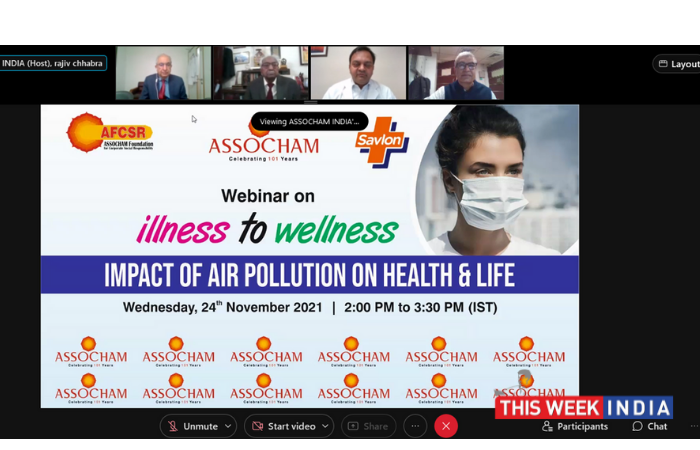
New Delhi, 25 November 2021: The Associated Chambers of Commerce and Industry of India (ASSOCHAM), the apex trade association of the country, with the objective to create awareness and enhance understanding about the severe impact of rising air pollution on human health and to mitigate its impact through preventive measures and effective actions, organised a webinar on ‘Impact of Air Pollution on Health & Life’.
The webinar was addressed by Prof. Lallan Prasad, Eminent Columnist, Prolific Writer, Economist and Social Activist, and top doctors which included: Dr. G C Khilnani, Former Head & Professor Department of Pulmonary Medicine & Sleep Disorders AIIMS, New Delhi Chairman, PSRI Institute of Pulmonary Critical Care & Sleep Medicine; Dr. Rajiv Chhabra, Chief Paediatric, Artemis Hospitals, Gurugram. The discussion was moderated by Dr. Rajesh Kesari, Founder and Director, Total Care Control.
Air pollution is the third most man-made potential catastrophe for the ecosystem as well as the health of all living beings including children, expected women, and elderly people. It is the leading cause of critical non-communicable diseases (NCDs) like cardiovascular diseases (CVDs), respiratory illness, lung cancer, stroke, including disabilities and deaths across the globe. Air pollution was responsible for nearly 14% of contribution to disability-adjusted life years (DALYs) due to NCDs in India in 2015.
Delving on the impact of air pollution on the economy, Prof. Lallan Prasad, Eminent Columnist, Prolific Writer, Economist and Social Activist commented, “According to WHO report, 7 million deaths happen per year globally due to air pollution and every second $9000 is spent across the world due to air pollution. This problem is more severe in South-Asia where countries like India register 18% of deaths annually due to air pollution which caused a total loss of 2,60,000 crore to the economy in 2019 alone.”
Commenting on the severity of air pollution in India particularly in Delhi, Dr. G C Khilnani, Former Head & Professor Department of Pulmonary Medicine & Sleep Disorders AIIMS, New Delhi Chairman, PSRI Institute of Pulmonary Critical Care & Sleep Medicine said, “Air pollution takes us from wellness to illness reducing life expectancy by almost 8 years. In Delhi, people have got used to this fait accompli where every year they will face breathing problems and other health-related issues due to noxious air during the winter season. Air pollution not only affects our immediate health but also makes us prone to several diseases starting from bronchitis, heart diseases, stroke, coronary artery disease, a variety of cancers, etc. During Covid, the severity of the infection and mortality rate was found to be extreme in regions where the air pollution is high. My sincere advice will be to vaccinate the elderly for flu and pneumonia, use N95 masks, avoid breathing exercise early in the morning, and use a good quality air purifier to reduce the ill-effect of toxic air on our health.”
Highlighting the impact of air pollution on children, Dr. Rajiv Chhabra, Chief Paediatric, Artemis Hospitals, Gurugram added, “Air pollution is a life sentence for an unborn child. It may lead to low birth rate besides impacting child health by making them predisposed to diseases like asthma. Air pollution can also hamper child development resulting in autism later in life. It is also associated with obesity which is the mother of all diseases. Against this backdrop, it is advisable to vaccinate children for diseases like influenza and pneumonia and take a diet rich in Vitamin C, antioxidants, and Omega fatty acids.”
The panel shed light on the economic impact of air pollution. It discussed how air pollution has hit the economy and productivity due to loss of working pollution and by increasing the government’s healthcare expenditure. It discussed the social cost of air pollution which impacts people’s movement leading to psychological problems due to limited social interaction and alteration in consumption behavior.
Initiating the panel discussion, Dr. Rajesh Kesari, Founder and Director, Total Care Control, said, “We all know about the impact of air pollution on human health. Polluted air is a major factor in the occurrence of critical NCDs besides significantly impacting the economy of the country and the state. This webinar on the impact of air pollution on health and life focusses on the factors responsible for air pollution, ways it is affecting our lives, country, and economy besides the remedies that we need to take to address this burning issue.”
The panelists were unanimous in their praise of ASSOCHAM India for organising this highly significant and timely webinar. They agreed that air pollution is the biggest threat to humanity and has wider economic implications for the country and the world. It is a preventable tragedy that can be averted only by the joint effort of individuals and government by devising and implementing necessary policies.
According to ASSOCHAM’s report on the rising burden of non-communicable diseases in India, air pollution is the most prevalent risk factor for NCDs with a prevalence of 76.4%. The survey, which is the largest in India, points out that every 3 out of 4 individuals are exposed to high air pollution making the risk of air pollution pervasive and relatively similar across all age groups. It found that the risk of air pollution is marginally higher for the younger population who are either studying or working.
The report observes that air pollution is a significant risk factor for respiratory diseases which include asthma, chronic obstructive pulmonary disease (COPD), pulmonary fibrosis, pneumonia, and lung cancer. Exposure to air pollution on the road increases the chances of developing respiratory diseases by 16%. Air particulate matter (PM) pollution, PM2.5, and PM10 particles can penetrate deep into the lungs’ passageways and are most harmful to health causing excessive premature mortality.
Air pollution affects skin diseases the most, increasing the chances by as high as 52%. Air pollutants may lead to skin aging, inflammatory or allergic conditions such as atopic dermatitis, psoriasis and acne, and skin cancer. Indoor air pollution such as workplace and household air pollution are major risk factors with a prevalence of 20.1% and 28.7% respectively. The report covered 2,33,672 people and 673 public health offices in 21 states to analyse the rising cases of NCDs and the social profile of suffering households.