Mysuru, July 3, 2025: In a landmark moment, Mysuru’s Excel Public School students to participate in a live interaction with astronaut Shubhanshu Shukla (VU2TNI), currently stationed aboard the International Space Station (ISS) as part of the Axiom Space AX-4 mission. The event, scheduled for Friday, July 4, 2025, at 3:47 PM IST, will take place through the Amateur Radio on the International Space Station (ARISS) initiative in coordination with the U.R. Rao Satellite Centre (URSC), Bengaluru. This is a rare and prestigious opportunity that allows students to establish direct communication with the ISS using amateur radio frequencies, an extraordinary instance of STEM education meeting real-world application. Excel Public School is the only school in the city to participate in this live Q&A.
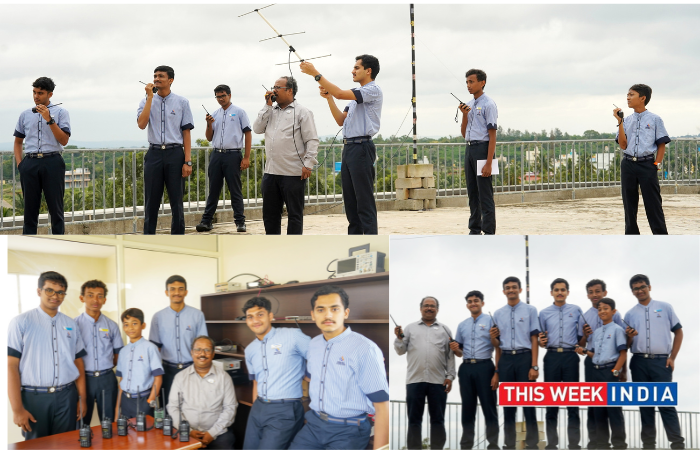
The licensed student HAM operators from Excel Public School, Bhuvan. PM (VU2NQH), Namasyu A (VU3IHV), Tanish Tejaswi. MS (VU2ITM), Pranav C N (VU3IIC), Vishruth. R (VU3IIB), and Sanat Raj G (VU3IHU) will represent the school in the ISS interaction, guided by their mentor and Amateur Radio club custodian, Mahesh. M B (VU2YYA). The contact will be made using amateur radio transceivers configured to uplink and downlink signals through the ARISS ground station infrastructure, allowing students to engage in Q&A from Earth to space via RF transmissions. The interaction will occur as part of a global network of scheduled ARISS school contacts that introduce young learners to space science, communications technology, and orbital research.
In a joint statement, the students from Excel Public School said, “As licensed student HAM operators, we’ve spent months learning the science behind radio communication, tracking satellites, and assembling and testing antennas. Being able to apply all of that by connecting with the International Space Station is an experience we never imagined we’d have at this stage in our learning journey. We’re proud to represent our school and our country in this rare opportunity, and we’re especially excited to ask questions we’ve always been curious about from life in space to the role of communication technology in such missions.”
“This contact is the result of sustained effort by the students, from clearing their ASOC exams to building antennas and decoding signals from the ISS. It’s a practical demonstration of what they’ve learned, and a moment they will carry with them for life,” said Mahesh MB, STEAM Coordinator, Mentor and Amateur Radio Club Custodian at Excel Public School
Excel Public School’s Amateur Radio Club, operating under the call sign VU2TQA, was licensed on November 6, 2023, by the Ministry of Communications, and has rapidly established itself as a beacon of innovation and learning in communication science. It is one of very few active HAM radio school clubs in India with licensed HAM operators. The club fosters high-impact technical training in HF, VHF, and UHF radio bands, antenna building, Morse code, and satellite telemetry.
The club’s achievements include receiving Slow-Scan Television (SSTV) transmissions from the ISS, live satellite tracking, and students excelling in the Amateur Station Operator’s Certificate (ASOC) licensing examinations. Excel Public School, recognized as an ISRO Space Tutor School, also conducts regular astronomy outreach, including night sky observations, workshops, and collaborative programs with the COSMOS and the Indian Institute of Astrophysics. These programs provide students with a unique opportunity to explore the universe and inspire them to pursue careers in space science.
According to Mathew KG, Principal, Excel Public School, “It’s a matter of great pride for our students to be part of this historic moment for India and to have the opportunity to speak to Mr. Shubhanshu Shukla aboard the ISS. Experiences like these are powerful reinforcements of our commitment to STEM education and to nurturing scientific curiosity through hands-on learning,”
Amateur Radio, often known as HAM radio, is a licensed, non-commercial system of wireless communication used by individuals around the world to experiment with radio technology, connect with others across long distances, and support emergency communication when conventional systems fail. It enables users to transmit and receive signals across various frequency bands, often reaching remote locations, ships, aircraft, and even satellites and space stations.
Globally recognized for its educational value, HAM radio encourages hands-on learning in physics, electronics, and atmospheric science. Through programs like ARISS (Amateur Radio on the International Space Station), it provides students with a unique opportunity to directly communicate with astronauts in orbit, turning theory into real-time scientific experience.