By Dr. Anupam Barik, Former Additional Commissioner (Oilseeds), Department of Agriculture & Farmers Welfare, Government of India, Krishi Bhawan, New Delhi
Agriculture today stands at the centre of the climate debate. The sector most essential for human survival also contributes significantly to global greenhouse gas emissions, drives large-scale land-use change and remains among the most vulnerable to rising temperatures, erratic rainfall and prolonged drought. These contradictions were on full display at the recent global climate conference in Belém, Brazil, where the Amazon and accelerating deforestation dominated discussions. The suspension of the Amazon Soy Moratorium this year further underscored the urgency of the moment, raising concerns about the future of one of the world’s most influential forest-protection agreements.
More Land, Lesser Production
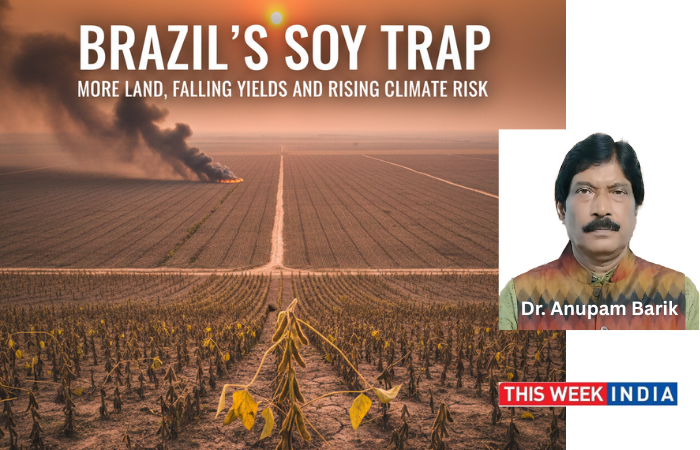
Brazil remains the largest soybean producer and exporter worldwide, and by 2023 its soy production had reached nearly 152 million tonnes, of which 127.3 million tonnes were exported. The soy trade accounted for about 16 per cent of Brazil’s total export revenues, roughly US$ 53 billion. Between 2020 and 2022, even as the area planted with soy grew from 37.2 million hectares to 41.2 million hectares, an increase of more than four million hectares, deforestation and land conversion due to soy also rose from 6,35,000 to 7,94,000 hectares. However, despite this expansion, output fell sharply. Brazil lost 14 million tonnes of soy in 2022 due to La Niña-induced droughts in the south. In some regions, yield losses exceeded what could be offset by planting more area. Multiple studies warn that future drought events are likely to occur with higher frequency, longer duration and greater severity. This trend could be especially harmful for Brazil, where 95% of agricultural production depends on rainfall.
This highlights a fundamental structural weakness of soybean cultivation: it is a land-intensive crop with relatively modest yield gains, particularly under climatic stress. Unlike higher-yielding oil crops that offer greater output per hectare, soybean expansion relies disproportionately on increasing cultivated area, making it both environmentally costly and economically fragile in a warming world.
The rise of soy also displaces cattle pasture. Data from 2008 to 2018 show Brazil lost 19 million hectares of pasture to cropland, predominantly soy, while converting 4.2 million hectares of native Amazon vegetation into new pasture.
This pattern reflects an expansion-driven model rather than efficiency-led growth, where land is repeatedly reallocated instead of degraded areas being restored or yields being improved. Such land churn increases pressure on forests and savannas without delivering commensurate productivity gains.
The shift in land use is not restricted to the Amazon. The other most affected area is Brazil’s tropical savannas, locally known as the cerrado, the country’s second-largest biome after tropical forests. In 2022 alone, soy-related conversion in this biome reached 375,000 hectares, more than three times the area cleared in the Amazon that year. This rapid conversion has begun altering hydrological cycles, disrupting rainfall patterns and intensifying climate stress across agricultural regions.
Beyond land conversion, soybean cultivation also raises concerns about input intensity. Large-scale soy farming depends heavily on chemical fertilisers, pesticides and water resources, contributing to soil degradation, water pollution and declining biodiversity. These hidden ecological costs further weaken the long-term sustainability of soy-led agricultural expansion.
Soy delivers mediocre yields, occupying 125 million hectares, i.e., nearly 30% of global oil crop area, while supplying just 28% of vegetable oil demand. Its expansion drives Amazon deforestation, releasing greenhouse gases and destroying biodiversity. It accelerates soil erosion, depletes topsoil carbon stores and generates significant emissions, particularly from soymeal and biodiesel production. The industry displaces local communities, including indigenous peoples, while destroying natural habitats. Despite economic benefits in some regions, soy expansion creates environmental degradation that outweighs short-term gains.
A Fork in the Road
At the same time, global demand for soy, particularly from China, the world’s biggest importer, continues to fuel Brazil’s soy expansion. This demand-side pressure, combined with weakened regulatory guardrails, amplifies the risks of renewed deforestation.
However, the more important challenge is the persistent drop in yields despite unprecedented expansion, which suggests that Brazil’s agricultural model is running up against ecological limits. Climate-sensitive crops like soy are among the first to suffer from altered rainfall patterns and prolonged droughts, turning expansion-based gains into long-term productivity losses. Climate change, expressed through droughts, altered precipitation and ecosystem disruption, is eroding the reliability of expansion-based farming. The coming years will show whether Brazil chooses to double down on expansion or take the path towards sustainable intensification, i.e., improving yield per hectare, restoring degraded pastures and reducing pressure on natural ecosystems. Unless such a transformation takes hold, Brazil risks deepening what is already a stark paradox: more land, less productivity and escalating environmental damage.
Lessons for India
Brazil’s experience offers valuable lessons for countries like India that are trying to balance agricultural expansion, climate adaptation and environmental sustainability. It is important to accomplish more per yield, without disturbing natural assets. This can be achieved through strengthening traceability, promoting high-yield and climate-resilient varieties, enforcing land-use regulations and encouraging farmers to adopt precision agriculture. Rewarding compliant farmers, instead of generalising blame, is crucial for ensuring widespread adoption of sustainable practices.
Soybean is a key oilseed under the National Mission on Edible Oils-Oilseeds (NMEO-OS), which envisages expanding the cultivated area from 13.2 million hectares to 14.5 million hectares and raising productivity to 1,900 kg/ha by 2030-31. With limited land availability and an urgent policy focus on achieving Atmanirbharta in edible oil production, India would benefit from closely examining the trajectory of soybean cultivation in Brazil, particularly in light of its implications for sustainability and potential impacts on biodiversity.
The real challenge lies in building systems that allow agriculture production and environmental production to coexist. The Amazon Soy Moratorium represents one of the most important experiments in aligning agricultural trade with forest conservation, and its future will play a decisive role in shaping global supply chain norms. As climate impacts intensify, the world must prioritise binding safeguards, transparent monitoring and science-based agricultural planning. Brazil’s soy expansion serves as a reminder that global agriculture must evolve rapidly to meet the twin imperatives of food security and climate sustainability, a priority that is equally relevant for India’s soybean pathway.