DKMS announces Free HLA typing for all children below 12 yrs suffering from transfusion-dependent thalassemia in India
Bengaluru, May 07, 2026: In the quiet corridors of a hematology clinic in Bengaluru, two strangers recently sat across from one another. On one side was Dilip K., a 27-year-old IT professional from Kolar with a gentle demeanor and a busy career. On the other was 12-year-old Sameeksha, a girl whose bright smile belied a decade of grueling medical battles.
Until that moment, they were connected only by a series of complex genetic codes stored in a global database. Today, they are the living embodiment of a miracle.
The Long Road to a Cure
Sameeksha’s life has never been defined by the typical milestones of childhood. Diagnosed with beta thalassaemia major when she was just a few months old, her world was shaped by the rhythm of hospitals and the necessity of regular blood transfusions. For children with transfusion-dependent thalassaemia, life is a delicate balancing act; while transfusions are a lifeline, they are not a cure.
“When Sameeksha first came to us, she was too young to understand what lay ahead,” recalls Dr. Siddhesh Kalantri, her consultant Haematologist. “Yet, she had a spirit that was evident to everyone. We knew that while we could manage her condition, a stem cell transplant was her only real shot at a normal life.”
In India, where over 10,000 children are born with thalassaemia every year, the search for a cure is often a race against time and a struggle against poverty. For Sameeksha’s family, the hurdles were twofold: the slim statistical probability of finding a genetic match and the staggering cost of the procedure itself.
A Random Act of Kindness
Years earlier, during a routine day at his college in Karnataka, Dilip K. came across a registration drive by DKMS Foundation India. It was a simple process—a quick swab of the inside of his cheek and a signed consent form.
“I didn’t think much of it when I registered,” Dilip admits. He went back to his studies, and later his career in IT, unaware that his DNA profile was now a beacon of hope sitting in an international registry.
Then, the call came. Dilip wasn’t just a donor; he was a perfect match for a young girl who had run out of other options. Without hesitation, he stepped forward. For him, it was a few hours of his time; for Sameeksha, it was the gift of a lifetime.
The Power of the Meet
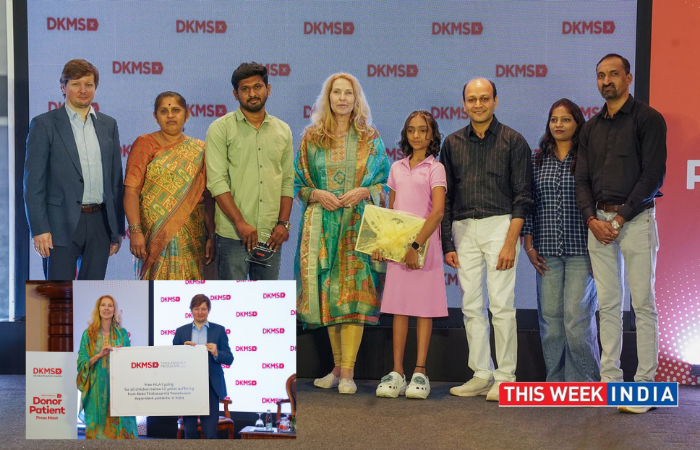
Following the successful transplant, the anonymity that usually protects donors and recipients was finally lifted. In the days leading up to World Thalassaemia Day, the two met for the first time.
The room was filled with a quiet, heavy emotion. “She is so full of life,” Dilip said, visibly moved after meeting the girl who now carries his healthy stem cells. “Until now, she was just a match on paper. Meeting her today makes everything real.”
For Sameeksha, the transformation is physical and profound. “I feel happy now,” she says. “I can play and go to school like other children.”
Breaking Barriers: DKMS and the Path Forward
Sameeksha’s story is one of triumph, but it also highlights a systemic challenge. Many families in India find themselves trapped between a life-threatening diagnosis and the inability to afford high-end treatments.
To bridge this gap, DKMS Foundation India has utilized its Access To Transplant program to provide financial support to families like Sameeksha’s. But they are going a step further. Marking this emotional reunion, the foundation announced a landmark initiative: Free HLA typing for all children below 12 years of age in India suffering from transfusion-dependent thalassaemia.
Patrick Paul, Executive Chairman of DKMS Foundation India, emphasizes that affordability should never be the barrier to a cure. By providing free HLA typing—the critical first step in identifying a donor—DKMS is removing the initial hurdle for thousands of families.
How You Can Change a Life
The story of Dilip and Sameeksha began with a simple buccal swab at a college campus. It ended with a young girl being able to dream of a future.
Currently, India faces a significant shortage of registered donors, particularly within the Indian population where genetic matches are most likely to be found. However, becoming a hero is simpler than most realize.
How to Register:
- Eligibility: Healthy adults between 18 and 55 years old.
- The Process: A simple, non-invasive swab of the inner cheek.
- Action: You can order a home swab kit through the DKMS India website.
Sameeksha’s father, who spent years in a state of “uncertainty,” now looks at his daughter and sees a world of possibility. “Meeting Dilip today is something we had only imagined,” he says.
What began as a routine registration for Dilip has become a life-changing story of hope. In the fight against thalassaemia, science provides the map, but it is the compassion of strangers that provides the cure.