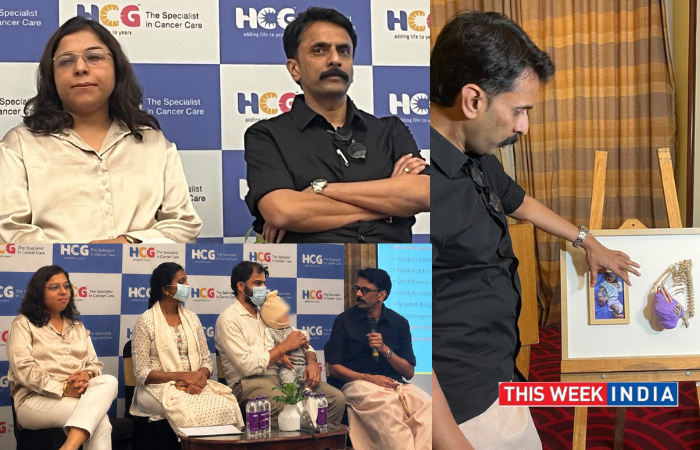
A multidisciplinary team of over 14 super-specialists leverages Digital Twin technology, genomic insights, and global collaboration to achieve historic limb salvage; community unites to raise ₹30–35 lakh for the newborn’s treatment.
BENGALURU, 15 July 2026 – In a historic milestone for pediatric oncology and orthopedic surgery, HCG Cancer Centre, Bengaluru, has successfully treated a 28-day-old baby girl battling an exceptionally rare soft-tissue cancer. The infant was diagnosed with Infantile Fibrosarcoma, a highly aggressive tumor that presented as a small swelling at birth but rapidly ballooned into a massive 11.3 cm × 9.8 cm growth, completely engulfing her right forearm and hand.
Before arriving at HCG, the devastated parents had consulted multiple hospitals, where medical consensus pointed to amputation as the only option to save the newborn’s life. Refusing to give up hope, the family approached HCG Cancer Centre, where a multidisciplinary team of 14 to 16 super-specialists mobilized advanced bioengineering, precision oncology, and international expertise to execute a high-risk, multi-stage treatment plan that ultimately saved both the baby’s life and her limb.
The Medical Challenge: A Race Against Time and Tissue Fragility
When the 28-day-old infant was admitted to HCG, her clinical status was critical. The tumor was a rapidly growing, fungating mass causing functional compromise of the right arm, accompanied by dangerously low hemoglobin levels.
Diagnostic imaging revealed that the tumor completely surrounded major blood vessels and essential nerves, rendering the limb incredibly fragile. To understand the molecular driver behind this rapid growth, the team ordered advanced genomic testing. The results revealed an NTRK gene fusion, a rare genetic alteration responsible for driving specific pediatric sarcomas, occurring in just 0.3 out of every 100,000 individuals.
Recognizing the extreme rarity and anatomical complexity of the case, Dr. Pramod S. Chinder, Director and Head of Orthopaedic Oncology at HCG, initiated an international consultation. The team collaborated with renowned global experts Dr. Marco Manfrini and Dr. Laura Campanacci from the prestigious Rizzoli Orthopaedic Institute in Italy. This international peer review validated HCG’s proposed limb-salvage strategy, providing the surgical team with the cross-border confidence needed to proceed with a highly ambitious, function-preserving approach.
A Meticulous, Staged Surgical Protocol
Given the baby’s fragile neonatal physiology and the tumor’s extreme vascularity (blood supply), operating immediately posed a catastrophic risk of fatal bleeding. The HCG team designed a highly controlled, multi-stage intervention spread over the course of a single week:
Stage 1: Super-Selective Embolisation Dr. Indu Shekar, Interventional Radiologist, threaded micro-catheters through the infant’s microscopic blood vessels to selectively block the main arteries feeding the tumor. This crucial preparatory step effectively starved the tumor of its blood supply, minimizing the risk of intraoperative hemorrhage.
Stage 2: Precision Neonatal Anaesthesia Simultaneously, Dr. Sunil Kumar H R, HOD of Anaesthesia, orchestrated a flawless neonatal anesthesia protocol. Managing a critically ill newborn through hours of complex surgery demanded micro-dosing of medications, rigorous thermoregulation to prevent hypothermia, and continuous hemodynamic monitoring.
Stage 3: High-Precision Resection Led by Dr. Pramod Chinder, the surgical team embarked on a grueling 7-to-8-hour tumor removal operation. Utilizing specialized micro-instruments and ultra-fine dissection techniques, surgeons separated the massive tumor from the infant’s delicate nerves and blood vessels without causing permanent structural damage.
Stage 4: Microvascular Free Flap Reconstruction Two days after the tumor removal, the plastic and reconstructive surgery team performed one of the youngest microvascular free flap surgeries ever documented globally. They transplanted a small tissue flap from the infant’s thigh to her right forearm, performing microvascular anastomosis (reconnecting microscopic blood vessels) to re-establish blood flow and ensure long-term hand functionality.
Pioneering Technology: Bioengineering and Digital Twins
The surgical team attributes much of the precision to cutting-edge digital planning tools. Before the first incision was made, HCG collaborated with The Purple Spark Bioengineering to create 3D-printed physical models of the infant’s arm. Furthermore, the team utilized Digital Twin technology to generate a three-dimensional virtual reconstruction of the baby’s unique anatomy using combined MRI and CT data. This allowed the super-specialists to visually map out every nerve pathway and blood vessel, minimizing intraoperative surprises and optimizing structural preservation.
A Triumph of Community Compassion
While the clinical battle was fought in the operating theater, a humanitarian effort was organized outside it. The total cost of this sophisticated care amounted to ₹30–35 lakhs, a sum far beyond the means of the struggling family.
Refusing to let financial constraints dictate the child’s survival, HCG Cancer Centre, alongside internal foundations and community leaders, catalyzed a massive fundraising campaign. Between 300 and 400 individuals united to pool resources. Contributions poured in from The Yellow Ribbon (Orthopaedic Oncology Unit), the HCG Foundation, the AaroCare Foundation, and a Milap crowdfunding campaign.
The initiative saw extraordinary generosity from hospital staff, doctors, friends, and ordinary citizens—including a group of ten students who collectively donated ₹20,000 from their personal savings. Major foundational backings from Dr. B. S. Ajaikumar and family, Ms. Manisha Kumar, Dr. Pramod S. Chinder’s family, Mrs. Ratnamma Shekarappa, Mrs. Geeta Swami, and Dr. Krithika Murugan ensured that the hospital could proceed with treatment without a single day’s delay.
To encounter an aggressive tumor covering the forearm and half the hand in a 28-day-old infant is to face a battle for life itself,” stated Dr. Pramod S. Chinder. “The rapid genomic diagnosis pinpointing the critical NTRK gene fusion was our turning point. It empowered us to execute a meticulous, multi-staged plan to save her life and preserve the future function of her hand. Parents should not panic when faced with a rare cancer diagnosis. Seeking treatment at specialized, integrated centers can make the ultimate difference between amputation and limb preservation.
Ms. Manisha Kumar, COO of Karnataka, HCG Cancer Hospitals, added This remarkable case reflects the power of multidisciplinary expertise, advanced technology, and compassionate care. At HCG, we are committed to ensuring that every patient has access to world-class cancer treatment, regardless of age or financial circumstances. This journey is a testament to what can be achieved through innovation, collaboration, and community compassion.”
A Healthy Future: 18 Months Later
Following the successful surgical intervention, the baby was started on child-safe Entrectinib, an advanced, NTRK-targeted inhibitor designed to eliminate residual microscopic cancer cells and prevent recurrence.
Today, one year and six months post-surgery, the child shows full limb preservation, exhibits no signs of cancer recurrence, and is hitting all her growth milestones like any healthy toddler. For the parents, watching their daughter move her fingers and play normally is a daily reminder of a medical miracle made possible by technological innovation and collective human kindness.