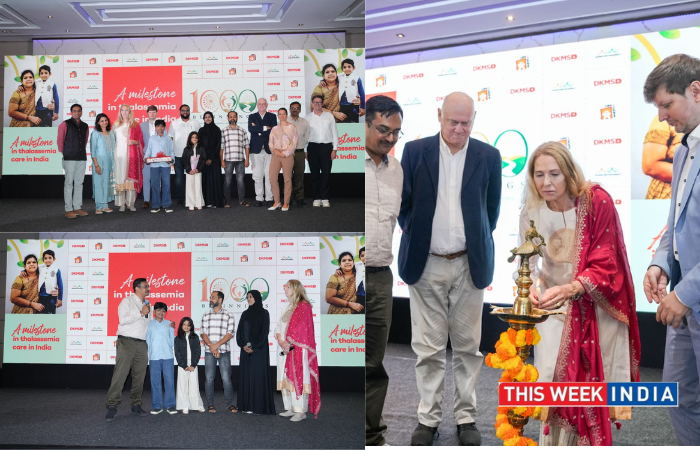
BENGALURU, India — 4 September 2026 — One thousand children, one thousand families, and one thousand new beginnings. Today, Sankalp India Foundation reached a monumental landmark of 1,000 paediatric stem cell transplantations. This milestone grants children suffering from severe inherited blood disorders, such as thalassemia major, the prospect of a vibrant, healthy life beyond lifelong blood transfusions and constant medical intervention.
The achievement will be formally celebrated in Bengaluru on 5 September under the banner “1,000 Beginnings.” The occasion highlights a decade-long international partnership uniting Sankalp India Foundation, the global non-profit donor organization DKMS, and medical knowledge partner Cure2Children Foundation. Together, the alliance has transformed access to curative blood cancer and blood disorder care across India.
Out of the 1,000 life-saving procedures performed through Sankalp’s network, DKMS has funded the transplantation costs for over 820 children. Over the past decade, this cross-border collaboration has evolved far beyond basic financial relief. Today, it encompasses comprehensive thalassemia management, specialized BMT (bone marrow transplant) infrastructure, advanced molecular diagnostics, healthcare provider training, and clinical research.
“One thousand transplants show what long-term partnerships can achieve. Sankalp brings extraordinary local expertise and commitment, Cure2Children contributes vital medical knowledge, and together we can help turn access to cure into a reality for more children,” stated Dr. Elke Neujahr, Global CEO of DKMS. “This is exactly the kind of sustainable collaboration we want to build: in the country, for the country.”
A Decade of Sustainable Impact and Growth
Sankalp launched its initial paediatric bone marrow transplantation initiative in Bengaluru in 2015 alongside Cure2Children. That same year, DKMS joined the effort, initially offering free High-Resolution Human Leukocyte Antigen (HLA) typing for patients and potential family donors.
Over the years, DKMS expanded its commitment significantly, funding specialized paediatric BMT units and molecular diagnostic facilities in Bengaluru and Ahmedabad. Beyond infrastructure, the joint effort focuses on capacity building through specialized nursing training and pioneering clinical research launched in 2025.
Today, Sankalp manages care for over 3,000 children across 30 dedicated thalassemia day-care centres and operates two state-of-the-art BMT units. Its preventive healthcare arm spans 87 screening centres across 81 districts, having already screened more than 220,000 couples.
“For us, these 1,000 transplants are 1,000 beginnings and proof that cure can be made accessible when organisations combine their strengths with a shared purpose,” noted Rajat Kumar Agarwal, President of Sankalp India Foundation. “Far more than numbers, this milestone validates our approach, showing that centres in resource-constrained settings can achieve world-class outcomes and internationally recognised quality while keeping treatment affordable.”
Setting the Global Standard: JACIE Accreditation
In addition to scaling capacity, the partnership has systematically raised the clinical standard for stem cell care in the region. The BMJH-Sankalp Centre for Pediatric Hematology Oncology and BMT in Bengaluru recently became the first transplant programme in India to achieve JACIE accreditation.
JACIE (Joint Accreditation Committee ISCT-EBMT) is the gold standard for quality management and safety in hematopoietic stem cell transplantation. Achieving this certification demonstrates that low-resource settings can maintain rigorous clinical care, collection, and processing protocols on par with top global medical institutions without inflating treatment costs.
“Bone marrow transplantation for children with severe thalassemia requires much more than medical technology,” explained Dr. Lawrence Faulkner, Founder and Medical Director of Cure2Children. “It requires highly trained teams, robust quality systems, and the ability to deliver complex treatment reliably. Reaching 1,000 paediatric transplants alongside JACIE accreditation demonstrates the maturity and world-class quality this programme has achieved.”
One of 1,000 Beginnings: Shaheem’s Story
Behind every statistic is a human story. Muhammad Shaheem, a young boy from Karnataka, was diagnosed with severe thalassemia major at just five months old. Years of bi-weekly blood transfusions led to dangerous iron overload in his liver and heart, turning a future transplant into a high-risk operation.
When his younger sister, Zara, was confirmed as a full HLA match, the team at the Sankalp-BMJH Centre prepared the family for the delicate procedure. The decision hit especially close to home for Shaheem’s mother, Zareena, who also lives with thalassemia major and understands the daily toll of the condition firsthand.
“As a mother, I wanted my son to have the chance of a life that is not determined by thalassemia,” said Zareena. “We were afraid, but the medical team gave us the confidence to move forward. Seeing Shaheem healthy today makes that decision worth everything.”
The Vision for 2047
Finding a matched donor is often only the first obstacle for families facing a complex blood disorder. The combined financial, logistical, and social barriers can keep life-saving care out of reach for vulnerable populations.
“Through our Thalassemia Program, we provide free HLA typing and donor searches, while our Patient Funding Program helps eligible families overcome financial barriers,” said Patrick Paul, Executive Chairman of DKMS Foundation India. “Working with partners like Sankalp allows us to connect these forms of support and help more children move from living with thalassemia toward the real possibility of a cure.”
Reaching 1,000 successful transplants strengthens the groundwork for the future. As Sankalp, DKMS, and Cure2Children scale up clinical infrastructure and preventive screening networks, they remain focused on their ultimate long-term goal: building a thalassemia- and hemoglobinopathies-free India by 2047.