KS Muralidharan
Diplomacy is usually conducted across negotiating tables. Modi-plomacy, however, knows when to let a photograph do the talking – because sometimes a single image can convey what no diplomatic note would dare put into words.
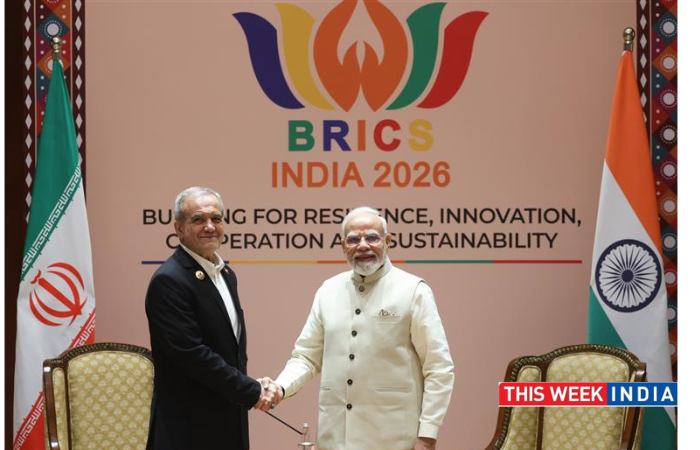
Consider one striking image from the BRICS gathering in New Delhi: Prime Minister Narendra Modi warmly accompanying Iranian President Masoud Pezeshkian, hand clasped in hand, both smiling before the cameras. In ordinary times, it might have passed as diplomatic courtesy. But these are not ordinary times. With the United States and Iran at war, the imagery acquired an altogether different strategic vocabulary.
The message to Washington was not that India had chosen Tehran over America. It was something subtler – and arguably more powerful: India will choose India.
Would any Indian Prime Ministers have risked such unmistakable optics at precisely such a moment? Modi’s foreign policy has demonstrated a willingness to do exactly that when national interest demands it: Engage Washington intensely, embrace Tehran publicly, buy Russian oil, negotiate with Beijing, work with the Quad and simultaneously strengthen BRICS. It is diplomacy stripped of the anxiety of having to belong permanently to somebody else’s camp.
That captures the significance of the 2026 BRICS New Delhi Declaration.
The Declaration is neither an anti-American manifesto nor a proclamation dethroning the dollar. India’s proposition is not to destroy the existing international architecture but to democratise it; not to replace one hegemon with another, but to give emerging powers sufficient strategic space to resist hegemonic pressure.
The world has changed; global institutions and economic rules must now change with it.
The expanded BRICS represents more than 40 per cent of humanity. More importantly, it is evolving from a grouping of rising economies into a collective bargaining platform for the Global South. Modi captured the ambition neatly: the Global South must move from being a “rule-taker” to a “rule-shaper.” Yet he simultaneously stressed that “BRICS is not against anyone.”
That combination defines India’s strategy.
America Is Not Named – But Its Shadow Is Everywhere
The Delhi Declaration’s language on unilateral tariffs, non-tariff barriers, sanctions and economic coercion is unmistakable. America is carefully not named, but Washington can hardly miss the message.
The larger warning is this: American economic power remains enormous, but unilateral use of that power encourages other countries to construct alternatives.
A geopolitical paradox follows. Sanctions encourage alternative payment systems; tariffs encourage alternative markets; financial weaponisation encourages local-currency settlement; diplomatic pressure encourages Global South solidarity.
BRICS is therefore not principally challenging America’s aircraft carriers. It is challenging the assumption that the world’s economic plumbing must invariably pass through systems over which Washington exercises disproportionate influence.
Yet predictions of the dollar’s imminent demise are exaggerated. India has made clear that there is no proposal for a common BRICS currency. The emphasis instead is on national currencies, cheaper cross-border settlements and interoperable payment systems.
The distinction is crucial:
Dollar dethronement – unlikely. Dollar diversification – already underway.
The future may therefore not produce a spectacular BRICS banknote. More consequential could be interconnected payment systems, local-currency settlements, financial messaging alternatives and expanded New Development Bank financing – essentially, alternative financial plumbing.
Optionality reduces dependence; reduced dependence creates negotiating power.
India’s Extraordinary Two-Way Leverage
This is where India’s strategy becomes particularly interesting. New Delhi has acquired leverage not only vis-à-vis Washington but also Beijing.
To Washington, India can effectively say: we remain indispensable to the Indo-Pacific balance, participate in the Quad, seek American investment and technology and value our strategic partnership – but our relationships with Russia, Iran and the Global South cannot be dictated from outside.
To Beijing comes the reverse message: India will cooperate within BRICS and support a more representative international order, but will not accept Chinese primacy as the price of multipolarity.
President Xi Jinping’s visit to India and engagement with Modi underline this dynamic. India can seek improved ties with China while continuing to raise concerns over the border, market access, supply chains and the enormous bilateral trade imbalance.
India therefore possesses leverage in both directions.
It can tell BRICS: “We have powerful Western partnerships.”
It can tell Washington: “We have other strategic options.”
That is strategic autonomy transformed from doctrine into negotiating capital.
Indeed, Washington has reason not to push India away from BRICS. Without India, the organisation could move considerably closer to a Sino-Russian geopolitical orientation. India’s presence acts as an internal balancing force against turning BRICS into an explicitly anti-Western coalition.
Conversely, India has no interest in replacing American predominance with Chinese predominance. Given China’s overwhelming economic weight within BRICS, New Delhi has good reason to prefer multipolar financial connectivity over a China-centric monetary alternative.
India’s Wider Diplomatic Footprint
The Declaration advances several other Indian interests. Its explicit condemnation of the Pahalgam terrorist attack and its language against terrorism, financing and safe havens reinforce India’s longstanding campaign against cross-border terrorism.
On energy and climate, BRICS strengthens India’s argument that energy transition must accommodate development realities rather than impose upon developing countries the historical burdens created by industrialised economies.
On AI, digital public infrastructure, manufacturing, critical minerals, resilient supply chains and technology, BRICS provides India another platform to project indigenous capabilities rather than remain merely a market for American or Chinese technology.
The Middle East simultaneously demonstrates BRICS’ possibilities and limitations. With Iran and the UAE within the same grouping amid war in the region, achieving consensus is itself significant. BRICS members need not agree on everything. They need only agree that disagreement should not require subordination to somebody else’s geopolitical camp.
Not BRICS Versus America
America nevertheless retains extraordinary structural advantages: The world’s dominant reserve currency, unmatched capital markets, formidable technology, military alliances, premier universities and immense soft power. BRICS has no common military command, common market, central bank or unified foreign policy.
But perhaps it does not need to become another NATO or European Union.
Its strategic purpose may be simpler:
to give countries alternatives.
And alternatives create autonomy.
The real BRICS-US contest therefore comes down to three words: Who makes rules?
The post-Cold War order largely assumed that the West would write the rulebook and emerging countries would operate within it. China’s alternative risks substituting one concentration of power for another. India’s proposition is potentially more attractive to the Global South:
Nobody should monopolise rule-making.
The Delhi Declaration should therefore not be interpreted as economic war against America. It is better understood as a declaration against over-dependence on any single centre of power.
For China, BRICS offers a route towards a less US-dominated order; for Russia and Iran, strategic breathing space; and for developing countries, greater bargaining power.
For India, however, BRICS performs perhaps the most sophisticated function: India can strengthen BRICS without becoming anti-American; cooperate with America without becoming an American ally; work with Russia without endorsing every Russian policy; engage China without accepting Chinese primacy; embrace Iran without inheriting Iran’s conflicts; and champion the Global South without withdrawing from the Western economic system.
That may be the real Delhi Doctrine.
India is no longer merely balancing between competing power centres. Increasingly, it is attempting to make those power centres compete for India.
Which brings us back to that remarkable photograph. The Modi-Pezeshkian handshake was not a declaration against Washington. It was a declaration of India’s freedom of manoeuvre.
Sometimes diplomacy is conducted across negotiating tables. Sometimes a photograph tells the world that India intends to sit at every table – but on nobody else’s chair.
The Delhi Declaration may thus signify something larger than another BRICS summit: the gradual transition towards a genuinely multipolar international order, with India positioning itself not on one side of the divide but increasingly as an indispensable bridge across it.
It would now be interesting – and geopolitically revealing – to see how the United States and the West respond to the Delhi Declaration.