BENGALURU, September 23, 2026 — Schoolchildren traveling along Bengaluru’s SH-35 corridor are now spending nearly two hours a day on school buses, with average daily travel times increasing 22% over the past two years, according to a comprehensive mobility study commissioned by Inventure Academy.
The study reveals that average daily school-bus commutes climbed steadily from 92 minutes in the 2024–25 academic year to 102 minutes in 2025–26, reaching 112 minutes in 2026–27. Afternoon return journeys took the hardest hit, rising from 53 to 65 minutes. Across the nine school routes analyzed, seven required more than an hour for the afternoon trip alone, with vehicles crawling at an average speed of just 9.2 km/h across the entire network.
The research focuses on the congested SH-35 corridor and adjoining arterial roads connecting Whitefield, Varthur, Gunjur, Sarjapur, and Dommasandra. This tightly constrained network of narrow roads and overburdened junctions services 42 schools, over 1,000 school buses, and more than 40,000 students and staff every single day.
At the current daily average of 112 minutes across a standard 200-day academic year, a student spends approximately 374 hours commuting—equivalent to nearly 53 seven-hour school days. Over a two-year period, this lost time equates to more than an entire academic term spent sitting in transit.
Live traffic data recorded on September 17 illustrates the daily reality for thousands of young commuters:
- A 4.1-km stretch from Varthur-Sarjapur Road to Inventure Academy took 36 minutes.
- An 8.4-km journey from Sarjapur to Gunjur Village took 63 minutes.
Beyond slow speeds, transit schedules have become highly unpredictable. The study found that 60% of all recorded trips arrived past their scheduled time, 15% were delayed by at least 10 minutes, and 4% were late by 30 minutes or more. On six of the 22 school days monitored, at least one bus suffered a delay exceeding an hour.
- K. Misra, B.PAC Member and mobility expert who has spent over a decade working on solutions for the corridor, emphasized the severe burden placed on young children. “Imagine a child taking two to four hours just to travel to and from school,” Misra noted, stressing the urgent need to repair long-standing infrastructure gaps along the stretch.
Nooraine Fazal, Founder, CEO, and Managing Trustee of Inventure Academy, as well as a B.PAC Member, highlighted the personal toll these delays take on families:
“Children and faculty who moved closer to school specifically to reduce their commute are expressing deep frustration as buses travel at almost walking speed. Walking is not a safe alternative, given the lack of continuous footpaths, accumulated garbage, dust, noise, and vehicular pollution.
The impact extends far beyond hours spent in traffic. After-school activities are regularly canceled, robbing children of vital time for play, family interaction, rest, and learning. Some children return home visibly distressed, drained of the physical and mental energy needed for their evening. We appreciate recent traffic police interventions and heavy-vehicle restrictions, but long-term solutions—including completing critical road projects and building safe pedestrian networks—must be accelerated.”
Sinduja T S, Principal at The Foundation School, Gunjur, echoed these concerns regarding road quality: “The current condition of these roads, coupled with temporary patch-ups, is a matter of genuine concern. Our students and faculty spend almost twice the expected time in traffic every day, which takes an inevitable toll on well-being and health. Lasting infrastructure solutions must be prioritized.”
Comprehensive Action Plan Recommended
To address the immediate crisis and build long-term resilience, the study outlines a structured roadmap for civic, traffic, and urban planning authorities:
1. Immediate 30-Day Interventions
- Traffic Management: Station traffic police at all critical junctions during peak school hours and enforce existing heavy-vehicle bans.
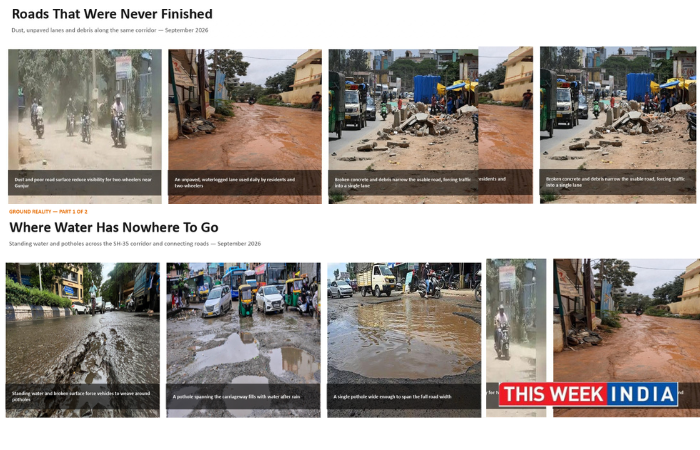
- Road Maintenance: Rapidly fill potholes, clear road obstructions, and streamline junction movements.
- Incident Response: Establish a rapid-response team to clear vehicle breakdowns and sudden congestion bottlenecks immediately.
- Accountability: Assign a named agency owner, clear deadline, and public progress tracker for every intervention.
2. Medium-Term 90-Day Improvements
- Apply scientific junction-management plans to restore maximum usable road width and repair shoulders and drainage.
- Formalize mandatory heavy-vehicle timing controls during school rush hours.
- Standardize civic protocols for roadwork diversions and execute tailored action plans for known traffic hotspots.
3. Long-Term Mobility & Infrastructure Goals
- Complete pending road widening and flyover construction at key bottlenecks: Dommasandra Circle, Gunjur, Varthur Kodi, Vibgyor Road–Kundalahalli, and Gran Carmen.
- Upgrade pedestrian pathways, improve drainage systems, and recalibrate traffic signal sequences.
- Reduce single-occupancy vehicle trips by incentivizing school bus usage, carpooling, and implementing staggered school and office hours.
- Evaluate dedicated school-bus lanes on narrow corridors and expand public mass-transit connections.
The report concludes that transport optimization at the individual school level cannot solve a systemic regional failure. Only a coordinated effort across road, traffic, and civic agencies can deliver safe, predictable, and timely commutes for Bengaluru’s students.