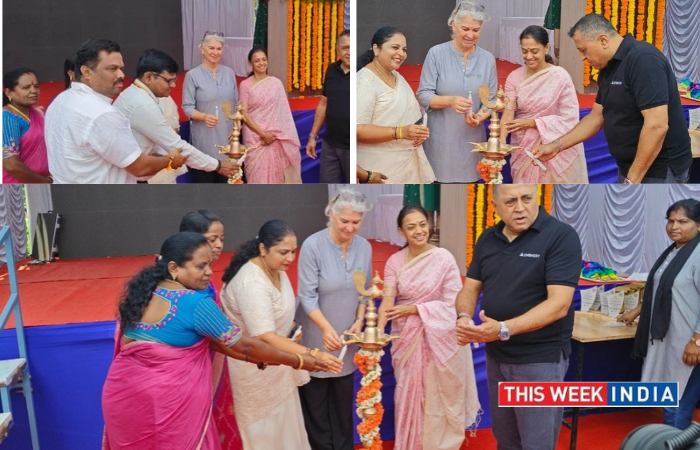
Bengaluru, October 10, 2026: The EcoGram Project, a flagship initiative of The Anonymous Indian Charitable Trust (TAICT), has celebrated ten years of transforming waste, water, and soil management across rural North Bengaluru. What started in 2016 as a small pilot in Tarahunise village has expanded to cover 10 villages and 4,802 households in partnership with the Bettahalasuru Gram Panchayat.
Over the past decade, the programme has established a sustainable, scalable model for rural waste management. By FY26, EcoGram successfully saved 19,623 cubic metres of landfill space—equivalent to roughly 16 acre-feet—and recycled 1,524 metric tonnes (MT) of dry waste. Its holistic environmental interventions have also:
- Conserved 3,343 MWh of energy and 1,505 KL of fuel.
- Saved 8,647 trees through targeted paper recycling.
- Reduced 5,583 MT of $\text{CO}_2$ equivalent emissions.
At the core of EcoGram’s success is an integrated waste management framework built around the 2Bin1Bag model and the EcoHub—the Panchayat’s Integrated Solid Waste Management Centre. Covering everything from daily collection to secondary processing, the system has driven primary source segregation rates past 96% in recent years. Wet waste is converted through composting and biomethanisation, while dry waste is systematically sorted for recycling.
“Introducing source segregation where the practice had never existed was an uphill task,” said Myriam Shankar, Managing Trustee of TAICT. “It required sustained engagement with local government, villagers, and businesses alongside the infrastructure needed to make it work. Over the past decade, we have built an end-to-end model with the active involvement of the local community.”
Supported since its inception by Embassy Group, the initiative highlights the power of public-private partnerships.
“The most important lesson from EcoGram is that lasting environmental change begins with local ownership,” noted Jitendra Virwani, Chairman of Embassy Group. “What has taken shape here is a practical model that other communities can learn from and adapt to their own needs.”
Beyond waste management, EcoGram has spearheaded extensive ecological restoration. The project supported the upkeep and beautification of Tarahunise and Thimmasandra Lakes through bund strengthening, vetiver planting, and floating treatment wetlands. Today, biodiversity assessments at Tarahunise Lake document 469 species. Additionally, agroforestry efforts transformed 11 acres of water-intensive eucalyptus plantations into native Malabar Neem and Silver Oak.
EcoGram also integrates social empowerment with sustainability:
- Skill Building: Launched in 2022 with the Yuvalok Foundation, the Threads of Life programme has trained 169 local women in tailoring and vocational skills.
- Textile Upcycling: Through the ReThread initiative, trainees have upcycled over 1,280 products using post-consumer textile waste.
Commemorating Ten Years
The decade milestone was commemorated at the EcoHub in Bettahalasuru, bringing together community members, frontline waste workers, and project partners. Smt. Meena Sheshadri, wife of Shri Krishna Byre Gowda, Hon’ble Minister for Greater Bengaluru Development, attended as Chief Guest alongside Mr. Virwani as Guest of Honour.
During the event, frontline workers were felicitated, and 30 Gram Panchayat members were recognised for their leadership. The Bettahalasuru Gram Panchayat’s pioneering work through EcoGram has previously earned national recognition, including the prestigious Gandhi Grama Puraskar Award for Sanitation.