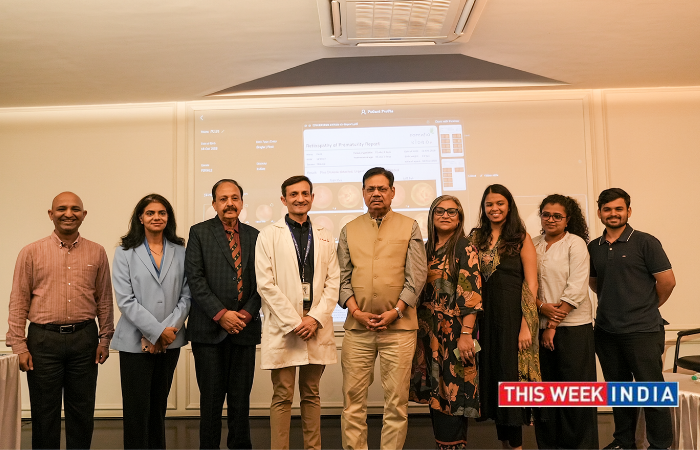
Bengaluru, November 17, 2026: Prompt retinal examinations are critical to preventing lifelong vision loss in infants born prematurely. This urgent message anchored a World Prematurity Day media briefing hosted today by the Indian Retinopathy of Prematurity Society (iROP) and Narayana Nethralaya in Rajajinagar, Bengaluru. The event spotlighted India’s ongoing push to broaden screening access for retinopathy of prematurity (ROP) and celebrated the regulatory approval of a new artificial intelligence (AI) solution designed to help clinical teams quickly identify high-risk retinal scans for specialist evaluation.
With approximately 30 lakh premature births recorded every year, India carries the highest burden of prematurity globally. ROP occurs when abnormal blood vessels develop in the fragile retina of a preterm baby, often advancing silently without outward symptoms visible to parents. Early detection, consistent follow-up, and timely medical intervention remain the primary defenses against permanent childhood blindness.
Marking a major technological leap, the Central Drugs Standard Control Organisation (CDSCO) has granted approval for the ROP AI software. Co-developed by medical device innovator Remidio and the KIDROP program—with backing from the Government of India’s Biotechnology Industry Research Assistance Council (BIRAC)—the tool evaluates bedside retinal photographs in real time, flagging suspicious cases so ophthalmologists can prioritize urgent reviews.
Clinical guidelines stipulate that infants born weighing under 2,000 grams or delivered prior to 34 weeks of gestation must undergo their initial ROP evaluation within 30 days of birth. Depending on overall health and additional clinical risk factors, neonatologists may advise even earlier assessments. Typically, an infant requires three to four consecutive screening sessions before specialists can definitively confirm the retina has matured safely without ROP complications.
“Over the past decade, iROP has expanded from a small circle of mentors into a nationwide network exceeding 300 specialists,” noted Prof. Rajvardhan Azad, President of the Indian Retinopathy of Prematurity Society. “Our immediate goal is to educate parents, caregivers, and policymakers while scaling cost-effective screening models across every corner of the country.”
Operating since 2007 as a public–private partnership with the Government of Karnataka, Narayana Nethralaya’s KIDROP initiative has pioneered decentralized ROP care. Its mobile screening teams currently serve over 175 neonatal intensive care units across Karnataka, delivering specialized diagnostics directly to the hospital bedside.
“To date, KIDROP has evaluated 1,14,738 infants, completed over four lakh screening sessions, and delivered 6,493 sight-saving treatments,” shared Dr. Naren Shetty, Director of Narayana Nethralaya. “All treatments are offered completely free of cost to babies born in government hospitals. Beyond initial care, we track these children long-term to evaluate their functional vision in everyday life and manage other prematurity-related health needs.”
“During the COVID-19 pandemic, we began replicating the KIDROP framework outside Karnataka after witnessing its sustained local impact,” explained Dr. Anand Vinekar, Founder Program Director of KIDROP and Principal Investigator for the ROP AI initiative. “Collaborating with the Have A Heart Foundation and regional medical teams, we have expanded into ten additional Indian states. By October 2026, this alliance had screened over 28,000 infants nationwide and surpassed 2,000 treatments, while also assisting clinical teams in several African countries. As emerging programs launch, AI will play a vital role in accelerating technician training and routing critical cases to specialists faster.”
“Developing this AI for ROP screening represents a landmark achievement in neonatal ophthalmology. Working alongside KIDROP with support from the Department of Biotechnology, Government of India, we merged clinical insight with homegrown engineering to build an offline-capable platform that detects and grades ROP even in low-connectivity regions,” said Dushyantsinh Anopsinh Jadeja, Senior Vice President – AI & Software at Remidio.
Healthcare leaders advise parents of preterm infants to consult their neonatal care team prior to hospital discharge to confirm whether an ROP exam is required, along with the exact schedule and clinic location. Adhering strictly to every follow-up visit is essential, as the condition can escalate rapidly between appointments even when a baby’s eyes appear entirely healthy.
About the Indian Retinopathy of Prematurity Society (iROP) Established in July 2016, iROP unites retinal specialists across India to eliminate preventable blindness caused by premature birth. The society standardizes national screening and treatment protocols, fosters clinical knowledge sharing, supports scientific research, and expands care into underserved regions through capacity building and technology.
About KIDROP Karnataka Internet Assisted Diagnosis of Retinopathy of Prematurity (KIDROP) is Narayana Nethralaya’s flagship tele-ROP initiative. Founded in 2007 with the Government of Karnataka, it stands as India’s first and one of the world’s largest tele-screening networks, utilizing trained technicians for bedside imaging and remote specialist grading. Having screened over 114,000 infants and treated more than 6,650, KIDROP actively mentors programs across ten other states.
About Remidio Remidio is a pioneer in AI-enabled ophthalmic diagnostics, transforming eye examinations into gateways for broader systemic health insights. As the first company to earn CDSCO approval in India for adaptive ophthalmic AI alongside European Class II EU-MDR CE certification, Remidio’s FDA 510(k)-registered and CE-marked devices have screened over 16 million patients across 55 countries. Born 15 years ago from a shared vision to decentralize affordable preventive care, Remidio continues advancing early detection for retinal and systemic diseases globally.