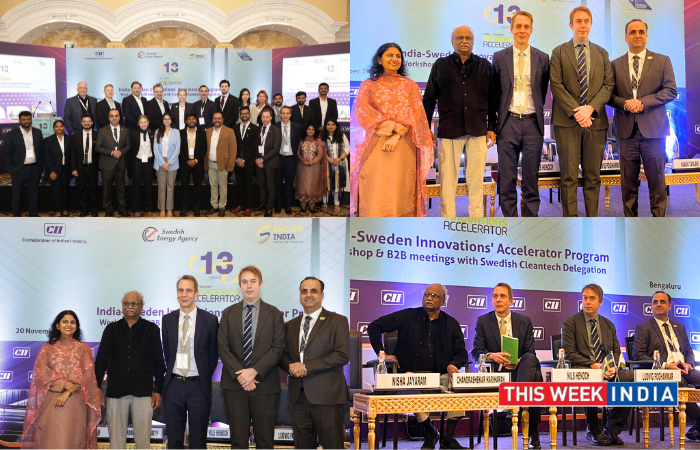
Bangalore, 20 November 2025 – Amidst escalating global climate risks and the urgent need for a clean energy transition, the India–Sweden Innovation’s Accelerator (ISIA) program hosted a crucial workshop and B2B meetings in Bangalore today. This event is a cornerstone of the 13th edition of the ISIA program, a pioneering bilateral initiative dedicated to fostering green technology collaboration and accelerating the adoption of advanced sustainable solutions in India, particularly in Karnataka.
The ISIA program, supported by the Swedish Energy Agency and implemented by Business Sweden – The Swedish Trade and Invest Council and the Confederation of Indian Industry’s Sohrabji Godrej Green Business Centre (CII-GBC), Hyderabad, has played a vital role in deepening bilateral cooperation in the cleantech sector since its inception in 2012.
For over a decade, ISIA has been a catalyst for clean technology transfer and business establishment. The program has successfully introduced more than 75 Swedish cleantech companies to the Indian market, facilitated over 250 collaborative projects, and enabled the establishment of seven local subsidiaries. These efforts have not only promoted sustainable practices but have also contributed significantly to national initiatives like the ‘Make in India’ and ‘Swachh Bharat Mission’.
The current edition of the program features nine innovative Swedish companies visiting India from November 18–25, 2025, to engage directly with Indian industry stakeholders. The Bangalore workshop and B2B meetings on November 20th provided a platform for these companies to present cutting-edge solutions across key areas: green energy, water management and conservation, energy efficiency, e-mobility in waterways, green propulsion and propellant, energy management, resource management, grid management, and solar module solutions.
Shared Vision for a Green Future
The workshop commenced with an inspiring welcome address by Dr. Chandrashekar Hariharan, Immediate Past Chairman, IGBC Bangalore Chapter and Trustee, AltTech Foundation. He highlighted that India’s sustainability journey is now entering a decisive phase, requiring an intensified focus on resource efficiency, energy-efficient technologies, and process optimization. He expressed confidence that the workshop would catalyze scalable solutions and impactful partnerships necessary for a sustainable, low-carbon future.
Mr. Pawan Tahlani, Head of Business Sweden – New Delhi, delivered the theme address, underscoring the common vision for a green future shared by India and Sweden—a vision driven by innovation, sustainable economic growth, clean energy, and decisive climate action. He positioned the ISIA program as a practical expression of this shared commitment, designed to facilitate the success of Swedish companies in India while providing Indian partners access to proven, high-impact clean technologies. Mr. Tahlani stressed that India, with its rapidly growing energy needs and firm commitment to a low-carbon trajectory, is a critical market for Swedish expertise in smart and renewable energy, circular economy, and efficient resource management. He strongly advocated for deeper industry-to-industry collaboration to accelerate the deployment of cleantech solutions that boost competitiveness while simultaneously reducing carbon intensity.
Mr. Nils Henoch, Senior Business Developer – International Market Development & Investment at the Swedish Energy Agency, provided the special address, reaffirming the Agency’s long-standing commitment to enabling global energy transformation through innovative technologies and strategic international partnerships. He highlighted the ISIA program as a cornerstone of Sweden’s engagement with India. Mr. Henoch pointed out that the eight Swedish companies showcased proven solutions in renewable energy, circular economy, and resource efficiency, all specifically tailored to meet India’s rapidly evolving needs. Highlighting Sweden’s global leadership in cleantech and climate innovation, he reaffirmed the Agency’s dedication to deepening cooperation and co-creating solutions to accelerate the transition toward a low-carbon, resilient future.
Mr. Ludvig Foghammar, Economic Counsellor and Head of Trade, Economics & Cultural Affairs, Embassy of Sweden, New Delhi, emphasized that the India–Sweden partnership rests on the foundation of sustainability, digitalization, and innovation. He noted that the green transition has become a central pillar of the bilateral relationship, stressing, “It’s time for Sweden, especially time for India.” He highlighted the strong complementarities between Sweden’s global leadership in renewable energy, waste-to-value solutions, and sustainable mobility, and India’s national priorities. Mr. Foghammar stated that the ISIA platform reflects the shared vision of both governments to jointly foster innovation, strengthen industry connections, and address global climate challenges. He expressed confidence that the workshop and B2B engagements would forge new avenues for collaboration, investment, and technology-led partnerships that support both nations’ long-term sustainability goals, reaffirming the Embassy’s continued support in facilitating policy and industry linkages.
Following the inaugural session, the workshop featured presentations from eight leading Swedish cleantech companies. These presentations showcased advanced technologies in critical areas such as electric water mobility, solar innovation, electro-fuel and green fuels propulsion systems, water and energy optimization, and industrial process efficiency.
The India–Sweden Innovation’s Accelerator stands as a strong symbol of robust bilateral collaboration, effectively fostering partnerships among innovators, industries, and institutions from both nations. The Bangalore workshop, which attracted over 50 eminent industry leaders, government agencies, associations, and technology providers, strongly reaffirmed the shared vision for a sustainable, inclusive, and low-carbon future. It emphasized the urgent need for deeper cooperation across innovation ecosystems, research partnerships, and financial mechanisms to effectively translate cleantech innovation into large-scale climate action.