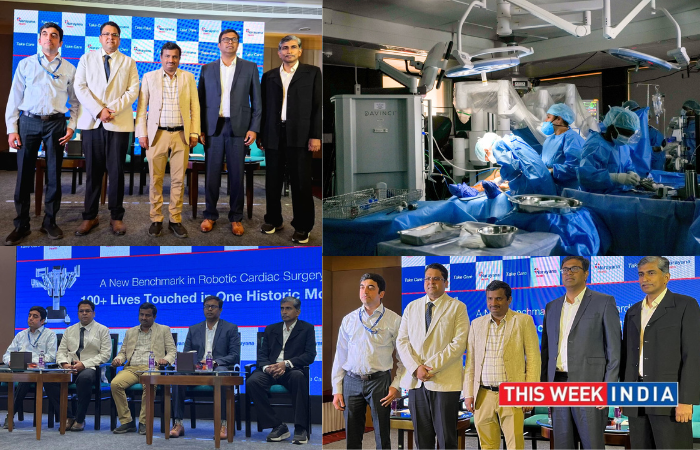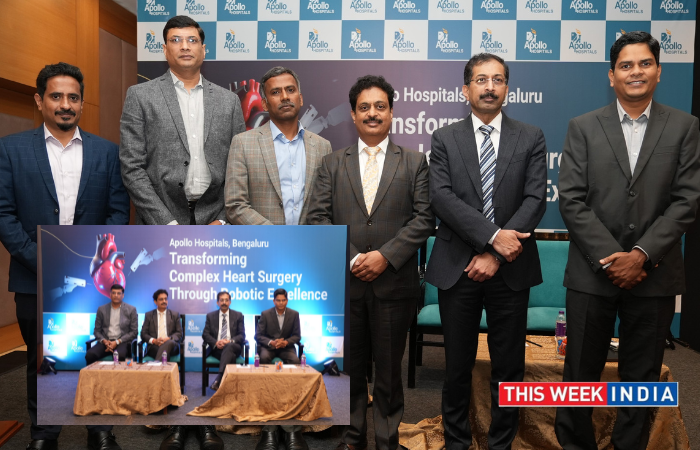
Bengaluru, 09 December 2025: Apollo Hospitals, Bengaluru, has cemented its position at the vanguard of cardiac surgery by successfully performing a highly sophisticated, rare, and complex robotic double valve replacement (DVR) on a high-risk patient. This milestone, achieved using the state-of-the-art Da Vinci Xi Surgical System, positions Apollo among an elite few centers across India capable of executing such a demanding multi-valve procedure using modern, advanced robotic platforms.
A High-Risk Case and a Minimally Invasive Solution
The patient, a 53-year-old woman, presented one of the most challenging profiles for cardiac intervention. Her primary diagnosis was infective endocarditis, a serious condition that had resulted in the severe, destructive damage of both her aortic and mitral valves. Compounding this significant cardiac pathology was a constellation of complex comorbidities, including rheumatoid arthritis, obesity, thyroid dysfunction, and a previous stroke. Given these factors, she was deemed a prohibitive, or at the very least, a substantially high-risk candidate for conventional open-heart surgery, which involves a large midline incision through the breastbone (sternotomy).
The surgical team, under the expert leadership of Dr. Sathyaki Nambala, the renowned cardiac surgeon and Chief of Robotic Cardiac Surgery at Apollo Hospitals, Bengaluru, strategically opted for the minimally invasive robotic approach. This decision was pivotal in mitigating the severe risks associated with traditional surgery in a patient with such a compromised health status. The Da Vinci Xi Surgical System provided the necessary high-definition 3D visualization, tremor-free fine motor control, and ergonomic precision required for maneuvering within the confines of the heart to perform the double valve replacement.
While the concept of robotic double valve replacement had been reported in India over a decade ago, those initial attempts were limited to first-generation robotic systems, often with significant technical constraints. Today, Apollo Bengaluru has not only re-established this procedure but has significantly advanced its application into the modern era of cardiac surgery.
This landmark surgery involved the simultaneous replacement of both the aortic and mitral valves with bioprosthetic valves. Crucially, the entire procedure was performed through small, keyhole incisions on the chest wall, entirely avoiding the midline sternotomy. The precision of the robotic instruments, combined with continuous intra-operative monitoring via transesophageal echocardiographic (TEE) guidance, ensured impeccable placement and function of the new valves. This marks a profound breakthrough, bringing complex multi-valve replacement fully into the domain of minimally invasive, robotic-assisted cardiac care in India.
The clinical outcomes achieved in this high-risk patient were nothing short of extraordinary, emphatically demonstrating the safety, precision, and patient-centric advantages of advanced robotic cardiac surgery. The patient’s recovery trajectory was dramatically accelerated: she was extubated and mobilized within a mere 12 hours post-surgery. She was transferred from the critical care unit to the general ward shortly thereafter and was remarkably discharged on the third postoperative day.
At her one-week follow-up, the patient remained completely asymptomatic and in excellent health, a testament to the reduced surgical trauma, minimal blood loss, and faster healing characteristic of the robotic approach.
Dr. Sathyaki Nambala emphasized the broader significance, stating, “This achievement represents a major milestone not only for Apollo, but for the cardiac surgery community in Asia. Performing this with next-generation robotic platforms introduces an entirely new level of precision, control, and safety, allowing us to reinvent what is possible in complex multi-valve surgery through a truly minimally invasive approach.”
Mr. Akshay Oleti, CEO – Apollo Hospitals, Karnataka, highlighted the convergence of expertise and technology: “Dr. Sathyaki and his team reached this milestone through their unmatched experience of over 3,000 minimally invasive cardiac procedures and more than 600 robotic cardiac surgeries. This feat showcases how advanced robotic platforms, combined with highly skilled surgical teams, enable us to safely perform some of the most complex cardiac procedures, reflecting our commitment to leading the next era of precision-driven cardiac care.”
This highly successful robotic double valve replacement solidifies Apollo Hospitals, Bengaluru’s leadership in modern, minimally invasive cardiac care, promising safer, faster, and more effective treatment options for even the most complex and high-risk patients.