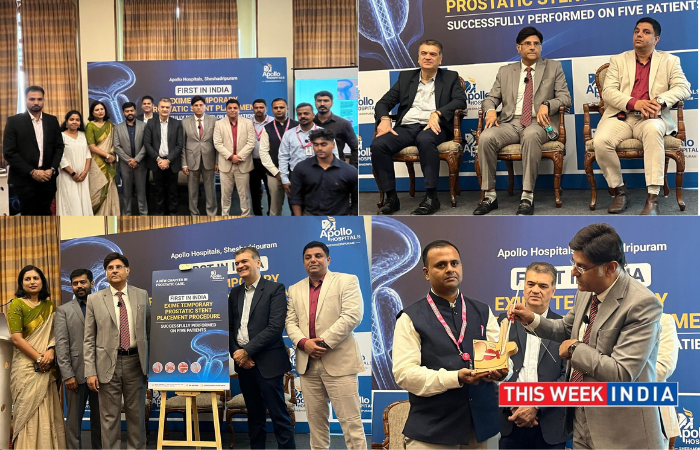
BENGALURU, 17 SEPTEMBER 2026 — In a major breakthrough for minimally invasive urological care, Apollo Hospitals, Seshadripuram, Bengaluru, has become one of the first medical centers in India to successfully implement EXIME Temporary Prostatic Urethral Stent technology. Led by Dr. T. Manohar, Clinical Director at the Apollo Prostate Institute, the clinical team performed the procedure on five high-risk patients, offering a vital alternative to conventional surgery for complex Benign Prostatic Hyperplasia (BPH) cases.
The EXIME temporary stent is engineered to maintain an open prostatic urinary passage, allowing patients to void urine naturally while awaiting definitive intervention or when traditional surgery carries prohibitive risk. Designed to remain safely in place for up to one year, the temporary device creates a critical therapeutic window to stabilize underlying health conditions, manage complex medication regimens, or plan future treatment.
Targeted Clinical Applications
The initial cohort of five patients presented severe medical complexities where standard prostate surgery had to be deferred:
- High-Risk Cardiac Care: A 73-year-old patient with recurrent urinary retention, infections, and a history of severe urosepsis—recovering from recent cardiac arrest and requiring continuous blood thinners.
- Oncology Care: A 70-year-old patient undergoing palliative treatment for metastatic urothelial cancer, deemed unfit for radical prostate surgery.
- Post-Cardiovascular Interventions: Two patients (aged 66 and 83) suffering from acute urinary obstruction following Percutaneous Transluminal Coronary Angioplasty (PTCA), whose surgical options were delayed due to mandatory dual antiplatelet therapy.
- Advanced Geriatric Care: A 90-year-old patient with multiple comorbidities and bladder dysfunction, previously dependent on long-term catheterization.
Immediate Outcomes and Minimal Invasiveness
Executed as daycare interventions under local anesthesia with light sedation, each procedure took an average of just 10 minutes. All five patients achieved immediate catheter-free status, voiding successfully right after placement with zero post-void residual urine. No complications were reported during a three-week follow-up period.
“For medically vulnerable patients, our primary challenge is relieving acute urinary obstruction without introducing surgical risks,” said Dr. T. Manohar, Innovator and Clinical Director, Apollo Prostate Institute, Renal Sciences & Kidney Transplantation. “We view this as a Least Invasive Surgical Treatment (LIST) option. It fills a critical gap for BPH patients experiencing severe side effects from medication or those who must delay definitive surgery.”
Addressing Gaps in Urological Care
The EXIME device is not a replacement for gold-standard surgeries like HoLEP or TURP in fit candidates. Rather, its strength lies in precise, temporary intervention for patients constrained by antiplatelet therapy, ongoing cancer care, or severe frailties.
Uday Davda, Vice President of Apollo Hospitals, Seshadripuram, emphasized the institution’s commitment to patient-centric innovation: “Expanding non-surgical choices significantly impacts quality of life for complex patients. Introducing EXIME reflects our focus on bridging care gaps through precise patient selection and rigorous outcome tracking.”
Looking ahead, the clinical team at Apollo Hospitals is actively exploring Indian modifications to temporary prostatic stents, including size-adjustable designs to enable customizable, patient-specific anatomy fitting.