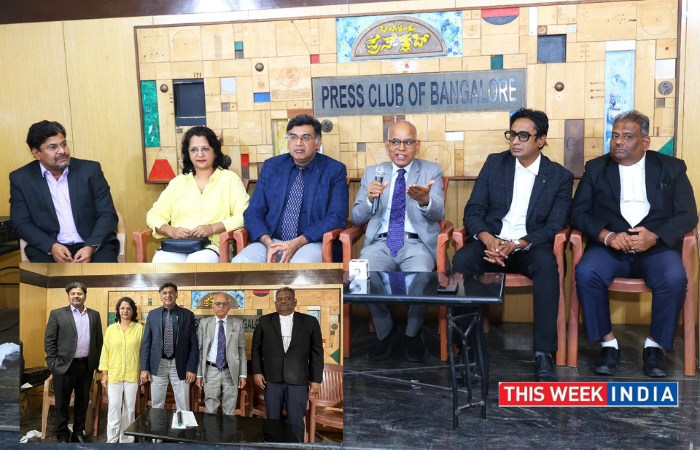
Bengaluru, December 18, 2025: The Advocates Association, Bengaluru, in association with Rebooting the Brain (PRS Neurosciences), hosted a press briefing and panel discussion titled “Neuro Justice Framework: Motor Accident Cases – Head Injury Disability and Medical & Legal Pain Points” at the Bangalore Press Club.
The panel was graced by Hon’ble Shri Justice A. V. Chandrashekar, Former Judge, High Court of Karnataka, Advocate Vivek Reddy, President, Advocates Association, Bengaluru, Advocate Chethana Bhat, Senior High Court Advocate, Karnataka, Prof. Dr. Sharan Srinivasan, Stereotactic & Functional Neurosurgeon, CMD, PRS Neurosciences and Head of Neurosciences, Bhagwan Mahaveer Jain Hospital, Bengaluru, Dr. Prathiba Sharan, CEO & Chief Medical and Rehabilitation Director, PRS Neurosciences, and Dr. Manjunath, Insurance Advocate. The discussion brought together eminent voices from the judiciary, legal fraternity, neuroscience, rehabilitation, and insurance law to address one of the most under-recognised challenges in motor accident compensation that is functional neurological disability arising from head, spinal cord, and nerve injuries.
The panel highlighted that while India recorded 1.77 lakh road accident deaths in 2024, official figures fail to capture the vast number of survivors left with lifelong neurological disabilities many of which are invisible, delayed in presentation, and difficult to measure using conventional medical reports.
Motor accident claim cases form a significant contributor to tribunal and court pendency, particularly when neurological injuries are involved. Courts are often required to assess lifelong functional disability and loss of earning capacity based on anatomy-centric medical opinions that do not adequately reflect real-world functioning, employability, or independence.
Neurological injuries often leave no visible scars. A person may walk, speak, and appear “normal,” yet struggle to return to work, make everyday decisions, manage emotions, or live independently. These are injuries that quietly dismantle a life without showing up clearly on scans.
Because the disability is not obvious, survivors are frequently met with doubt rather than understanding. Families are pushed into repeated hearings and prolonged legal battles to prove what cannot be easily seen. The result is not only inconsistent compensation, but years of emotional, financial, and legal strain adding to court backlogs while deepening the trauma of those already affected.
The discussion emphasised the urgent need for structured, task-based, and context-specific functional assessment systems, aligned with neuroscience principles and capable of translating medical complexity into court-ready functional conclusions. The responsible use of AI as a judicial decision-support tool to improve consistency and reduce pendency while preserving human judgment was also deliberated.
Beyond litigation, the panel framed neurological disability as a human-capital and development challenge, directly impacting India’s demographic dividend and the vision of Viksit Bharat 2047. Preventable road trauma and unrecognised disability, speakers warned, silently erode productivity, family stability, and public trust.
Addressing the gathering, Justice A. V. Chandrashekar (Retd.), Former Judge, High Court of Karnataka, underscored that courts are not equipped with scalable tools to translate complex neurological impairments into legally usable conclusions, despite repeated judicial recognition of the problem.
Legal experts noted that motor accident claims involving neurological injuries form a substantial portion of pending cases, where lack of standardised functional assessment leads to disputes, appeals, and delays which impacts victims, insurers, and the justice delivery system alike.
Medical experts from PRS Neurosciences emphasised that there is no single test or scan that can measure real-life brain function, making task-based, contextual, and longitudinal assessment essential for fairness and accuracy.
Panelists collectively stressed the need to move beyond survival-based outcomes and recognise functional dignity as central to justice delivery. They called for:
- Formal recognition of functional neurological disability in motor accident jurisprudence,
- Structured, standardised assessment methods that courts can rely on,
- Responsible use of AI as a decision-support tool, not a substitute for judicial discretion,
- Periodic reassessment mechanisms for long-term neurological injuries
The discussion also marked the beginning of a broader National Neuro Justice Movement, aimed at creating sustained collaboration between legal institutions, medical experts, and policymakers to address road trauma as a long-term human capital and justice issue. This movement aimed at shifting India’s approach from anatomy-based evaluation to functional justice rooted in lived reality.