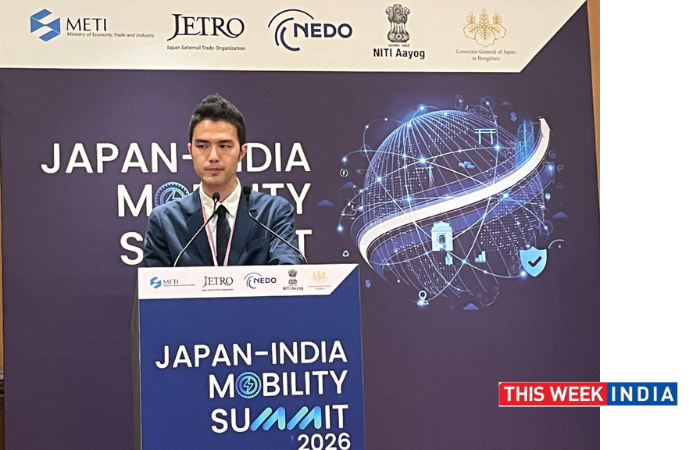
BENGALURU, March 9, 2026 – Today, at the Taj West End in Bengaluru, the Japan–India Mobility Summit 2026 (JIMS 2026) convened to solidify a strategic alliance between two of the world’s most influential economies. The summit focused on accelerating bilateral cooperation in clean energy, digital mobility, and industrial innovation, emphasizing how Japan’s engineering excellence and India’s massive digital scale can co-create the future of global transport.
Supported by Japan’s Ministry of Economy, Trade and Industry (METI), the Japan External Trade Organization (JETRO), and the New Energy and Industrial Technology Development Organization (NEDO)—in partnership with NITI Aayog—the event gathered over 200 leaders from government, automotive OEMs, Global Capability Centers (GCCs), and mobility startups.
JIMS 2026 served as a critical milestone in operationalizing the Next-Generation Mobility Partnership (NGMP) and the Initiative of Clean Energy Mobility and Infrastructure for Next-Generation (ICEMAN). The discussions revolved around three core pillars:
- Multi-Pathway Decarbonization: Exploring diverse solutions including EVs, green hydrogen, biofuels, and flexible-fuel vehicles (FFVs).
- Digital & Smart Mobility: Advancing Software-Defined Vehicles (SDVs), MaaS (Mobility as a Service), and BaaS (Battery as a Service).
- Ecosystem Synergy: Strengthening ties between Japanese technology leaders and India’s thriving startup and supplier networks.
Mr. Keisuke Hosonuma, Director for Automotive International Trade Policy at METI, emphasized that carbon neutrality is not a “one-size-fits-all” journey. “Different markets require solutions based on their unique economic realities,” he noted. “India is a critical partner, offering immense opportunities for innovation and scale.”
Echoing this sentiment, Dr. V. K. Saraswat, Member of NITI Aayog, highlighted the shift from infrastructure building to deep-tech collaboration. “The next phase of our partnership must move toward technology co-creation—from hydrogen mobility to integrated platforms. This is a structural redesign of energy, data, and industry,” he stated.
The choice of Bengaluru as the host city underscores Karnataka’s status as a premier global hub. Dr. S. Selvakumar, Principal Secretary for Commerce and Industries, Government of Karnataka, highlighted the state’s Clean Mobility Policy 2025–2030. With over 800 R&D centers and a dense cluster of automotive engineering talent, Karnataka provides the ideal ecosystem for Japanese firms to pilot and scale next-generation solutions.
The summit was bolstered by industry giants including SIAM, JAMA, ACMA, CII, and FICCI, ensuring a direct bridge between policy intent and industrial execution. By merging Japan’s engineering depth with India’s AI and software prowess, JIMS 2026 has set a new global benchmark for sustainable, integrated mobility.