Retailers Emphasise Robust Enforcement and Fair Market Practices to Protect Consumers and Safeguard Millions of Small Retailers
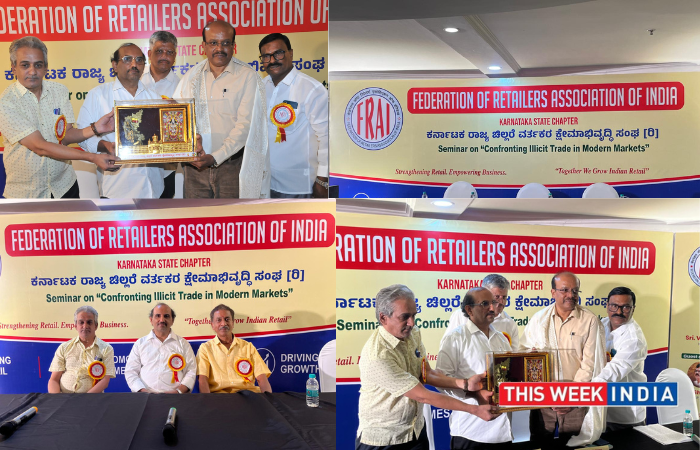
Bengaluru, 08 September 2026: The Karnataka State Retail Traders Welfare & Development Association (R) hosted a high-profile seminar titled “Confronting Illicit Trade in Modern Markets” today at Regenta Place, Bengaluru. The event served as a crucial convergence point for independent retailers, prominent trade associations, and key policymakers to address two accelerating threats tearing at the fabric of India’s retail ecosystem: the alarming escalation of illicit trade and the prevalence of distorted, unfair market practices.
Attendees expressed deep concern regarding the unchecked circulation of counterfeit items, unauthorized distribution channels, and non-compliant goods across the commercial landscape. Furthermore, the discussion shed light on how predatory pricing, deep discounting loops, and the aggressive, rapid expansion of specific e-commerce and quick commerce models are generating severe operational imbalances for brick-and-mortar small businesses and traditional trade networks.
Stakeholders noted that these compounding pressures are eroding government tax revenues, shattering consumer trust, and directly jeopardizing the livelihoods of hundreds of thousands of micro and small traders across Karnataka.
The seminar drew esteemed figures from the state administration. Shri. Vijayananda Kashappanavar, Hon’ble Minister for Small Scale Industries & Public Enterprises, graced the occasion as the Chief Guest. He was joined by Shri. Rizwan Arshad, Hon’ble Minister for Food, Civil Supplies and Consumer Affairs; Shri. B.K. Shivaram, Retd ACP; and Shri. C. Govindappa, Joint Controller of Legal Metrology, who participated as Guests of Honour.
Setting the tone for the deliberations, B. N. Murali Krishna, President of the Karnataka State Retail Traders Welfare & Development Association (R), stated, “Illicit trade is no longer merely a commercial issue; it has become a serious threat to consumer safety, fair competition and the livelihoods of millions of honest retailers. Counterfeit and illegally sourced products not only expose consumers to substandard and unsafe goods but also undermine the credibility of legitimate businesses that operate within the law. The Association remains committed to working closely with the government, law enforcement agencies and industry stakeholders to strengthen enforcement, raise consumer awareness and build a transparent retail ecosystem where genuine businesses can thrive.”
While recognizing that e-commerce and quick commerce platforms have revolutionized convenience by offering instant accessibility, speakers argued that these exact digital infrastructures have inadvertently opened wide entry points for illicit trade. Flash sales, unrealistic discounting structures, aggressive pricing wars, and the relentless consumer demand for ultra-fast delivery have created an environment where buyers frequently struggle to distinguish authentic goods from clever counterfeits.
Participants highlighted that nearly every consumer category—ranging from everyday groceries, packaged foods, and personal care items to specialized skincare, consumer electronics, and high-end mobile phones—can now be delivered to doorsteps within minutes. However, this race for extreme accessibility and bottom-dollar pricing has allowed banned, illegal, and spurious merchandise to infiltrate the market on an unprecedented scale.
Unethical sellers and illicit syndicates are rapidly exploiting these expanding digital channels, leveraging weak monitoring frameworks alongside a growing consumer obsession with instant gratification and steep discounts. Retailers warned that as buyers increasingly prioritize low prices over product quality, fertile ground is being laid for illicit networks to flourish online.
The seminar emphasized that this shift is not only hazardous to consumers who receive low-quality, potentially unsafe items, but it is equally devastating for genuine offline retailers. Traditional shopkeepers invest years building community trust, verifying product authenticity, and maintaining rigorous accountability. Yet, uneven competition and predatory pricing make it nearly impossible for these traditional traders to survive, despite dedicating 14 to 18 grueling hours a day to keep their businesses afloat, support their families, and educate their children. Speakers underscored that this has transcended basic commercial competition to become a profound social and livelihood crisis for working-class micro-entrepreneurs.
Discussions further underscored that while small-scale traders operate on razor-thin margins under strict regulatory oversight, major digital platforms leverage massive capital reserves to dominate market share through aggressive discounting. Participants stressed that while technology and innovation are welcome drivers of progress, retail growth must remain balanced, fair, transparent, and inclusive.
Representing a powerful voice for the state’s commercial backbone, the Association encompasses over two lakh micro, small, and medium retail enterprises across Karnataka, directly advocating for the welfare of more than five lakh vulnerable retail families.
Toward the conclusion of the seminar, participants formulated a collective appeal, urging policymakers to enact stronger regulatory oversight, enforce fair competition guidelines, and establish a level playing field. They called for rigorous administrative measures to completely eradicate illicit and illegal products from the online retail ecosystem.
The event concluded with a unified call to action, reminding government bodies, policymakers, and industry leaders that safeguarding the interests of small retailers is essential to preserving India’s traditional entrepreneurial ecosystem—a foundational pillar of local commerce, employment generation, and long-term economic stability.