By Dr. Prashanth S Urs, Senior Consultant Neonatologist & Pediatrician Apollo Hospitals, Sheshadripuram, Bangalore
A white glow in a photograph, a new squint, or a subtle change in the appearance of an eye may seem insignificant. In some children, however, these can be the first clues to a potentially life-threatening cancer. Parents take hundreds of photographs of their children. Most capture ordinary moments of childhood—playing, laughing and growing up.
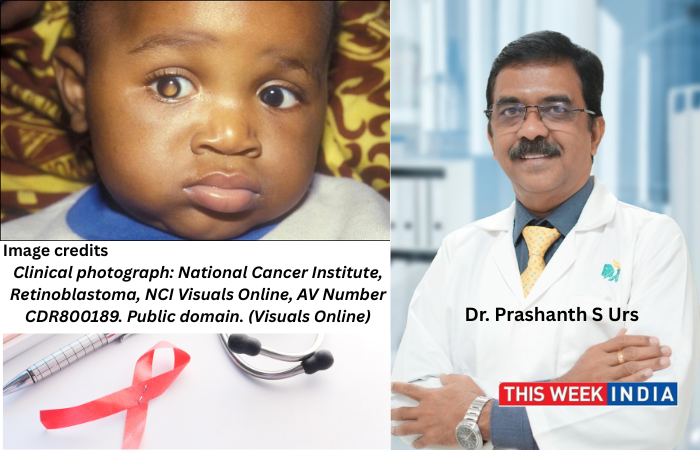
Occasionally, however, a photograph may reveal something that is difficult to notice in everyday life: an unusual white reflection in one of the child’s eyes. It may be nothing. But sometimes, it can be the first visible sign of retinoblastoma, a rare cancer that develops in the retina and primarily affects young children. (Cancer.gov)
When a photograph becomes a warning sign
One of the classic signs of retinoblastoma is leukocoria, or a white reflex from the pupil. Instead of the familiar red reflection seen in a flash photograph, one eye may appear to have a white or unusual glow. This is sometimes referred to as the “white eye” or “cat’s-eye” reflex.
A new or persistent squint can also be an important warning sign. Other possible features include an unusual appearance of the eye, redness or swelling, watery eyes, poor vision, or an eye that appears enlarged or protruding. (American Cancer Society)
These signs do not automatically mean that a child has cancer. Several other eye conditions can produce similar findings. The important message is that an unexplained or persistent change should not be ignored.
Why early recognition matters
Retinoblastoma can progress and, in advanced cases, can threaten both vision and life. However, early diagnosis and treatment can prevent the cancer from spreading and may help preserve the eye and useful vision, depending on the individual case. (Cancer.gov)
The challenge is that a young child may not complain about poor vision. If only one eye is affected, the child may continue to behave normally because the other eye compensates.
That makes the observations of parents—and sometimes something as simple as a photograph—particularly important.
WHEN SHOULD PARENTS SEEK MEDICAL ATTENTION?
Consult an ophthalmologist promptly if you notice:
- A persistent white or unusual reflection in one pupil
- A new or persistent squint
- One eye looking different from the other
- An unusual change in the appearance of the pupil or eye
- Persistent redness, swelling or watering
- An eye that appears enlarged or protruding
- Difficulty seeing or unusual visual behaviour
Look at your child’s eyes, The next time you look through your child’s photographs, take a moment to look at the eyes. Is the reflection in both eyes similar, Is there a persistent white reflex in one eye, Has a squint recently appeared, Does one eye look noticeably different from the other?
If something doesn’t look right, don’t rely on repeated photographs or wait for it to disappear. Have the child examined by an ophthalmologist.
An unusual reflection in a photograph does not by itself diagnose retinoblastoma. But an abnormal red reflex in a young child warrants evaluation to determine its cause.
A moment of attention can make a difference, Because sometimes, the first clue to a child’s illness may be hiding in plain sight—in their eyes.