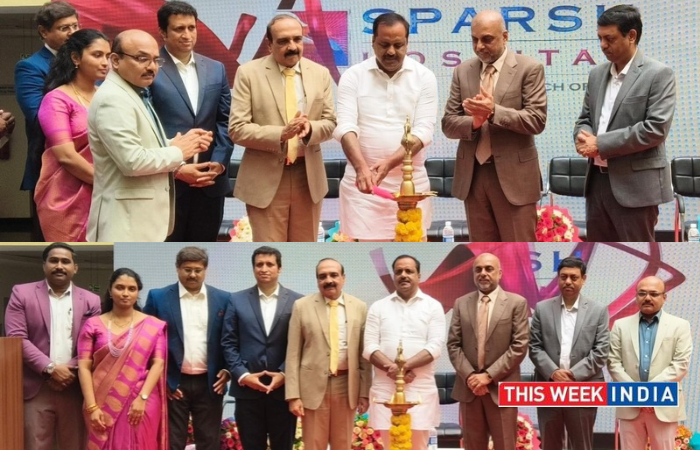
BENGALURU, December 25, 2025 — In a landmark event at the NIMHANS Convention Centre, India took a historic step toward transforming how the judiciary assesses human life and functional disability. The official release of the Neuro Justice Trilogy and the Neuro Justice Framework (NJF) Handbook marks a paradigm shift in the Indian legal landscape, moving from a traditional “symptom-based” approach to a sophisticated “function-based” justice system.
The trilogy and handbook, authored by renowned Functional Neurosurgeon Dr. Sharan Srinivasan and Neurorehabilitation expert Dr. Prathiba Sharan, were formally launched by Hon’ble Shri Justice Aravind Kumar, Judge of the Supreme Court of India. The high-level gathering was presided over by Shri Dinesh Gundu Rao, Hon’ble Minister for Health & Family Welfare, Government of Karnataka, in the presence of Hon’ble Shri Justice R. V. Raveendran, Former Judge of the Supreme Court of India.
Bridging the Gap: From Operating Room to Courtroom
The authors shared a deeply personal journey, reflecting on decades of seeing trauma survivors lose their fight for justice because their impairments were “invisible” on paper.
“We have seen patients survive trauma, only to lose justice because their ‘hardware’ and ‘software’ impairments were invisible to the system,” said Dr. Sharan Srinivasan. “Neuro Justice exists to translate complex brain science into judicially usable truth.”
Dr. Prathiba Sharan, CEO of PRS Neurosciences, emphasized the “invisible disabilities” like damaged memory and behavioral changes that are often uncompensated. “Function is how a person lives, thinks, and belongs. When assessments ignore this, families pay the price. This trilogy creates a shared language for rehabilitation, neuropsychology, and law.”
The Neuro Justice Framework (NJF) v1.0
A major highlight of the launch was the introduction of the NJF v1.0, India’s first operational, patent-pending model for measuring functional disability. The framework includes:
- The TAPS System: A Tri-Axis Participation System measuring impacts on Individual, Family, and Societal functioning.
- The NJF Triad: Three linked engines that evaluate a person’s pre-injury state, realistic restoration potential, and the compensation required to enable that recovery.
- Scientific Integration: Aligning the WHO-FIC classifications and the RPwD Act 2016 with everyday legal practice.
Voices of Support Across Sectors
Hon’ble Shri Justice Aravind Kumar noted that the work symbolizes the critical intersection of law, neuroscience, and ethics. Hon’ble Shri Justice R. V. Raveendran, known for his landmark judgments in Motor Vehicle Accident (MVC) cases, praised the authors for providing a roadmap for judges to navigate the complexities of neurological injuries.
Shri Rudrappa Lamani, Deputy Speaker of the Karnataka Legislative Assembly and a survivor of a devastating road accident involving brain and spinal cord injuries, provided a moving perspective. He spoke of the urgent need for affordable multi-disciplinary neuro-rehabilitation centers in every district, noting that even he was initially unaware of specialized centers like PRS Neurosciences.
The event also featured insights from Shri Seemanth Kumar Singh (Commissioner of Police, Bengaluru), Dr. Manas Panigrahi (President, Neurological Society of India), and Padmashri K. Y. Venkatesh (Paralympian), who highlighted the importance of returning injured individuals to a life of dignity.
A Closer Look at the Neuro Justice Trilogy
The trilogy serves as a foundational movement to ensure justice reflects the lived reality of neurological injury.
Volume 1 — Brain in the Dock: Understanding Circuits, Consciousness & Behaviour
This volume lays the philosophical groundwork, explaining brain architecture and linking physical structures to human cognition. It argues that “disconnection” in neural pathways is as vital as physical destruction in determining long-term independence.
Volume 2 — Trauma, Toxins & Thinking: Injury Physics, Survival Biology & the Algorithmic Brain
Examining the “Golden Hour,” this volume explores how early medical intervention dictates legal accountability. It covers neurotrauma, spinal cord biology, and the “Compromised Brain Behind the Wheel”—reframing negligence and road safety through a neurobiological lens rather than just moral judgment.
Volume 3 — The Justice of Function, The Function of Justice: Neuropsychology, Neurobehavior & WHO Disability Science
Focusing on “invisible” consequences like executive dysfunction and PTSD, this volume introduces the CAREPa-Re Framework, asserting that permanent disability cannot be concluded until professional rehabilitation has been attempted. It also provides a detailed analysis of nine landmark Supreme Court and High Court judgments (including Raj Kumar vs. Ajay Kumar and Sarla Verma vs. DTC) that insist compensation must reflect functional loss.
Impact and the Vision for Viksit Bharat 2047
India currently faces nearly 9 lakh pending motor accident claims. Compensation is often delayed beyond the critical rehabilitation window, leading to caregiver burnout and economic collapse for families.
Published in the public interest by the Swaasthya Aarogya Foundation Trust, the Neuro Justice Trilogy aims to:
- Reduce tribunal resolution times by 50%.
- Ensure fair and consistent legal outcomes.
- Position India at the forefront of global “function-first” justice.
As a beacon for Viksit Bharat 2047, this framework ensures that the law does more than just award a percentage of disability; it returns a person to their life.
About the Authors: Dr. Sharan Srinivasan is a leading Functional Neurosurgeon and Dr. Prathiba Sharan is a pioneer in Neurorehabilitation. Together, they lead PRS Neurosciences, an organization dedicated to the holistic recovery of patients with neurological impairments.